Joseph’s role in the Christmas story

The main human players in the Christmas story are Mary, Joseph and Jesus. Yet Joseph is often a secondary character, off to the side as it were, as if we are uncertain what to do with him. After the birth stories, Joseph disappears entirely from the narrative, while Mary has several more appearances.

In Matthew’s version of the Christmas story, though, Joseph has a more major role than Mary. He is the one who has to respond to Mary’s unexpected news about her pregnancy, he is the one who organises their escape to Egypt and he is the one who brings the family back to Nazareth. He is also the one who names the child Jesus. How much of this is historically accurate we don’t know, but Joseph is presented as someone who is upright in character, who stays calm and who is practical.

Joseph is a good example of a support person, the quiet behind the scenes person who gets things done and who serves in a no fuss way. So often in history, it is women who fulfil such a role, but here it is Joseph. What might we learn from his example, his trust in God and his practical action?

An alternative vision

This third Sunday in Advent is often called Joy Sunday, when we remember the song that is sung by Mary (called the Magnificat). Despite her challenging personal circumstances, Mary sings of God’s blessing and God’s alternative vision for the world that will come through her child, Jesus.

One of the interesting aspects of Mary’s song is that it is expressed in the past tense, as though God has already accomplished the overthrow of the rich and powerful and has already raised up the poor and fed the hungry. When we look at the world we realise that this alternative vision has not yet arrived. This may cause us to doubt and question like John the Baptist does in our second reading this week. Or we may rejoice with Mary and commit ourselves to help make this vision a reality.

In the words of an old Benedictine prayer, may God give us enough foolishness to believe that we really can make a difference in this world, so that we are able, with God’s grace, to do what others claim cannot be done.

Daring to say ‘yes’ to God

Clearly there were rumours circulating regarding the legitimacy of Jesus that both Matthew and Luke address in their own way. Matthew begins his story about Jesus with a stylised genealogy. Scattered among the more than 40 men are four women – Tamar, Rahab, Ruth and the wife of Uriah (i.e. Bathsheba). Each of these strong women have a somewhat dubious sexual history – forced upon them by men wielding privilege and power. These women help to introduce Mary, the wife of Joseph, of whom Jesus the Messiah was born (Matt 1:16).

The story of Mary’s encounter with the angel Gabriel in Luke 1:26-38 takes on new reverberations in light of the #metoo movement, as women report on unwanted sexual advances made against them. Did God take unfair advantage of Mary by overpowering her (Luke 1:35)? What would have happened if Mary had said ‘no’?

The result of Mary’s co-operation with God’s demand is that she holds the exalted title of Theotokos (God-bearer) and may be regarded as both a prophet (e.g. Luke 1:47-55) and model disciple (e.g. Acts 1:14). Although God may not ask of us something as dramatic as God called Mary to, the question remains whether we dare to follow Mary’s example and say ‘yes’ to God.

For a brief overview of the book of Matthew download

Welcome to the world of Matthew

Or download a Bible study with leaders notes that explores these 5 women.

Advent 1 Study – Adults Only Christmas Story

The hope and challenge of Advent

Welcome to the season of Advent, a time of waiting and preparing for the coming of Jesus. This first Sunday is often called Hope Sunday or sometimes Prophets’ Sunday. It is a day to remember the ancient words of the prophets pointing to the hope of transformation and justice, a hope born out of trust in God’s faithfulness to make things right.

Advent begins by acknowledging that there is much in our world that needs transformation, whether we think of violence and wars, poverty and inequality, the gathering climate emergency, or the growing number of displaced people looking for a safe home. Jesus told us not to be alarmed by such situations but rather to stay awake and to keep sharing the good news through our words and actions.

The challenge for us and every generation is that Jesus left no timelines or detailed plans for us to follow. So we have to read our context and respond as we are able. How does the season of Advent fill us with fresh enthusiasm and hope as we contemplate being agents of change in the world?

The king in God’s upside down kingdom

This Sunday is called Christ the King Sunday. The image of Christ as a king, seated on a throne, always seems slightly jarring. Yet the later writings of the NT often portray Christ as ruling at God’s right hand and, in the book of Revelation, as a figure of unimaginable power and glory.

What do we learn from this image? First we need to get our heads around the fact that Jesus is a King. That is what the title ‘Christ’ implies in Greek, which is a translation of the Hebrew ‘Messiah’, Anointed One or King. A better question is how did a crucified pretender king come to be known and worshipped as a king, and as a rival to Caesar.

Second, what sort of king is Jesus and what sort of kingdom does he reign in? Our discipleship has most likely taught us to regard Jesus as a servant king who establishes God’s upside down kingdom through his ministry of teaching and serving. Yet early Christian hymns such as the one found in the Colossians reading suggest a far wider role as co-Creator and as the reconciling agent between God and humanity, no less than the human face of the invisible God. Again, a better question is how will we approach this king – both in worship and in our everyday life.

Living in community

Building strong relationships is hard work. Of the many aspects involved, we might choose the following as important requirements: availability, mutual respect, communication, shared interests and time.

Leaders in the early church had a challenging role to bring communities together and help them come to a common sense of identity and purpose, given the diverse religious and social background of the members. The writer to the Colossians lists some key ingredients that they saw as necessary. One was obviously a shared faith in Jesus as Lord and recognition of the God of Israel as the one true God. Beyond these core faith commitments are listed compassion, kindness, humility, willingness to forgive, love and thankfulness.

This week as we come together with our friends from Croydon Parish Players to celebrate their 63 years of performing theatre together and to bless them for the next chapter in their journey, it is worth noting that what makes this group tick – beyond a shared passion for theatre and performance – is their emphasis on building Christian community. It is this aspect that attracts and grows their members. The question for all of us is how are we making the investments needed to build strong, deep and resilient communities?

Responding to critics

Life throws up various challenges – at a personal, community, national and even global level. How we respond to these challenges is a mark of our maturity and also our compassion. I remember clearly the response of President George Bush in the aftermath of the 9/11 attacks in the US – it was all about revenge, violence and instigating a war on terror. I also remember clearly the response of NZ Prime Minister Jacinda Ardern following the mass shootings in a mosque in Christchurch – that was focused on compassion and kindness. Only one of these leaders professes to be a Christian and only one of the responses is Christian. Yet words and actions do not always line up.

In this week’s Gospel reading, Jesus is confronted by some of his critics during the week leading up to his passion. The Sadducees were responsible for the running of the temple in Jerusalem and their opposition to Jesus is based on what they perceive as his threat to their power. They wish to entrap and eliminate Jesus, an approach similar to that of President Bush as described above. The response of Jesus is both wise and compassionate, more similar to the response of Prime Minister Ardern.

When we are confronted by critics and challenging situations, how do we respond? Do we follow the violent ways of the world or the ways of God’s upside down kingdom?

What do justice and peace look like?

The cry of the prophet Habakkuk still resonates strongly today. Why must we look at the world and see violence, destruction and injustice? Why does God not act? Why does justice often not seem to prevail? The Gospel story about Zacchaeus starts from a similar position … ‘why can tax collectors continue to rip off ordinary people and get away with it’, questions the crowd?

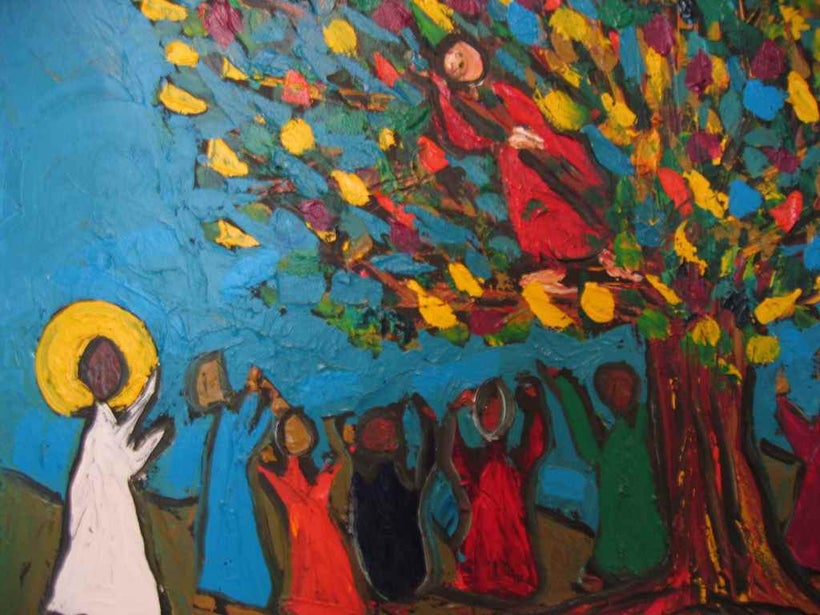
But when Jesus spots Zacchaeus looking down at him from a tree, Jesus sees something more than a disreputable tax collector. He sees an opportunity for transformation, for justice and for reconciliation. In the face of hospitality and grace, lives are changed. Jesus names this change as salvation, but he could also have said that peace and wholeness has come to the situation, both for Zacchaeus and for his neighbours.

The world often appears to be in a mess with justice and peace far off. The insight of Jesus is that even the most contentious issues and people can be transformed with a change of heart that leads to changed action. The message from the prophet is not to give up or give in to injustice but to be patient and work towards justice.

Relationship not rules

Many – if not most – Christians pray. In extremis, many non-religious people also pray. But why do we pray? We may pray out of a sense of desperation, or from a sense of Christian duty, or because we want to change the outcome of a situation. It seems that the desire or need to pray is fairly primal.

In this week’s Gospel reading from Luke, Jesus tells a parable about the contrasting prayers of two people. One of the people is deeply religious and appears to live a good life. His lengthy prayer reminds God of his devotion to following God’s ways. The second person prays a short prayer from the heart, acknowledging his brokenness and need for God’s help to turn his life around.

One prayer is focused on following rules while the other is wanting to restore relationship with God. One prayer comes from a place of self-confidence while the other is a cry for help and mercy. Which of these approaches does Jesus commend? Which approach is more typical of your prayer life?

Some essentials of faith

I wonder what you regard as being essential to your faith. Is it your personal relationship with God, strengthened through practices such as prayer and reflection on Scripture? Is it being part of a worshipping community who gather each week for encouragement? Is it the call to make a difference in the world through loving others and seeking justice?

This week’s readings offer some insights into what Jesus and Paul regarded as some essentials of our faith. The first is that our faith can often feel small and fragile. Jesus compares it to a mustard seed, while Paul notes that we can feel intimidated by those around us if we speak up about our faith. While our faith might be small, we have faith in a powerful God, who delights to work in and through our life through the Spirit.

The second insight is that our faith – thankfully – is built on God’s grace. There is nothing that we can or must do to earn God’s favour. This is a huge blessing and a truly distinctive part of Christian faith. It also means that we can make no demands on God. As Jesus reminds us, we are to regard ourselves as servants, following in his servant footsteps.

How are these insights informing your everyday faith?