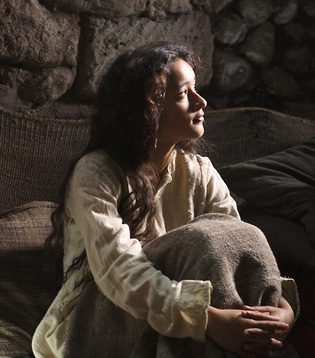
An adventure beyond the ordinary

This week, as we move a step closer towards Christmas, we hear the story of Mary receiving some most unexpected news. She is to have a son who will be named Jesus, who will rule on the throne of David and be called the Son of the Most High God. Mary asks how this will be since she isn’t even married. The somewhat mysterious response is that the power of God’s Spirit will come upon her.

We are probably too familiar with this story that we miss how scandalous it is at so many levels. Mary is young and as yet unmarried, so to become pregnant is a social scandal that will lead to innuendo, disgrace and possibly worse. What will she say to her parents and to her fiancé Joseph? Mary is also a nobody in the wider scheme of things. She comes from an ordinary family and from a very ordinary small village. She has no status, no connections.

But therein lies the beauty and mystery of this story – that God chooses to work through ordinary people like Mary living ordinary lives. God may well have seen qualities in Mary to suit her for this rather extraordinary role – a deep faith perhaps, courage and a sense of calm. Perhaps God sees these or other qualities in our lives. The most important characteristic though is that Mary says ‘yes’ to God’s invitation. She doesn’t know where this will lead or about the joys and challenges and griefs it will bring her but she says yes anyway. May we be inspired by Mary’s adventure beyond the ordinary.

The great inspiration of Mary

Christmas is nearly here and this week we light the fourth Advent candle, the candle representing love. Not the mushy sentimental love that features in Christmas movies and most nativity scenes but the practical and costly love that is at the heart of the biblical Christmas story.

Mary is both a recipient and a giver of this love. Gabriel greets her as someone who has found favour with God and who is given a unique role as the mother of God’s Son. Nothing in her life to this point would have indicated her readiness or worthiness for such a role. Hence Mary is perplexed but thankful that she has been chosen. Like many others in the gospel story she is a relative nobody just trying to live a faithful life and by God’s grace she becomes a conduit for God’s love to be revealed to the world.

She will of course give birth to Jesus and nurture him in faith as he grows up. She will watch as he begins his ministry of healing and teaching, and she will watch in anguish as he is later crucified. She will be part of the emerging Christian community of faith that gathers after the resurrection. She will love Jesus as only a mother can and will bear the cost of watching her son die.

Like others in the gospel narrative, she is not the central character but one of many characters that point to Jesus and the love of God revealed through him. I wonder how your life and your choices shine the love of God to those around you as you in turn point others towards Jesus.

This week we again have a combined collaborative service prepared by Heathmont, Ringwood, Ringwood North and our two Croydon congregations. You will see and hear from several familiar faces from Croydon and Croydon North. Join together at 10 am in your respective worship spaces or login at the following website https://nruc.online.church/ from 9.45 am.

Click here for worship@home resources.

Daring to say ‘yes’ to God

Clearly there were rumours circulating regarding the legitimacy of Jesus that both Matthew and Luke address in their own way. Matthew begins his story about Jesus with a stylised genealogy. Scattered among the more than 40 men are four women – Tamar, Rahab, Ruth and the wife of Uriah (i.e. Bathsheba). Each of these strong women have a somewhat dubious sexual history – forced upon them by men wielding privilege and power. These women help to introduce Mary, the wife of Joseph, of whom Jesus the Messiah was born (Matt 1:16).

The story of Mary’s encounter with the angel Gabriel in Luke 1:26-38 takes on new reverberations in light of the #metoo movement, as women report on unwanted sexual advances made against them. Did God take unfair advantage of Mary by overpowering her (Luke 1:35)? What would have happened if Mary had said ‘no’?

The result of Mary’s co-operation with God’s demand is that she holds the exalted title of Theotokos (God-bearer) and may be regarded as both a prophet (e.g. Luke 1:47-55) and model disciple (e.g. Acts 1:14). Although God may not ask of us something as dramatic as God called Mary to, the question remains whether we dare to follow Mary’s example and say ‘yes’ to God.

For a brief overview of the book of Matthew download

Welcome to the world of Matthew

Or download a Bible study with leaders notes that explores these 5 women.

Advent 1 Study – Adults Only Christmas Story