
Living with clarity or confusion

This week the Federal Treasurer, Josh Frydenberg, handed down the Budget. Clearly it was prepared with the imminent election in mind, with cash handouts to many and a temporary reduction in the fuel excise which will make petrol and diesel purchases some 20 cents per litre cheaper for motorists.

What is rather more confusing (or perhaps it’s clear …?) is the vision for Australia’s medium term future as outlined in the Budget. It would suggest that we need to spend rather less on addressing climate change than previously and spend nothing more on aged care (despite obvious issues in staffing numbers and pay) yet we can afford to spend billions of dollars on seemingly unimportant infrastructure projects in marginal electorates.

This week’s Gospel story illustrates the gulf between Jesus’ vision and that of the disciples. While Jesus is quite clear and open about the reception he will likely receive in Jerusalem (mocking, insults, flogging, death), the disciples remain confused and lacking understanding (thinking that Jesus will receive a hero’s welcome from the authorities in Jerusalem). The story of the blind man Bartimaeus receiving his sight illustrates that he sees clearly who Jesus is and what his needs are, even while the disciples remain in a fog of confusion.

As we continue to walk with Jesus on the road that leads to the events of Easter, I wonder whether we are clear or confused regarding what we are called to do as followers of Jesus. Where are we seeking to follow Jesus even though the road seems hard, and where are we following our own agenda even though it may be well wide of Jesus’ call? Where do we see clearly and where do we remain blind?
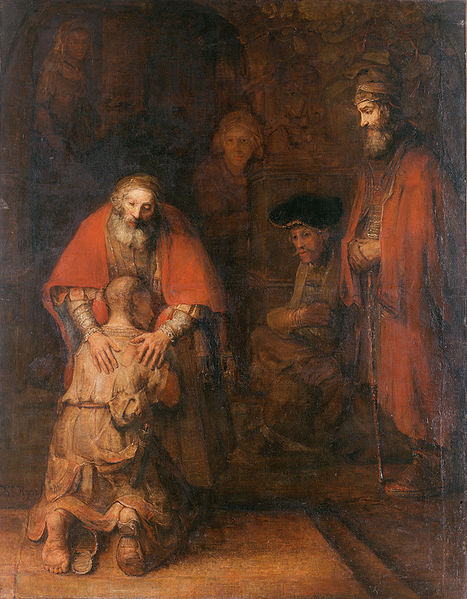

Towards the heart of the gospel

This week’s parable points us towards how we are to picture God. It’s the well-known parable of the Prodigal Son, in which a disrespectful younger son demands his share of the family inheritance and promptly spends all the money on wild living. When he is broke, hungry and without friends, he returns home, hoping to be taken on as a hired labourer. His father sees him returning from afar, rushes to welcome and embrace him and throws a big party to celebrate the son who was effectively dead now being alive again.

Most religions claim to offer a source of comfort and guidance. They provide a basis for moral beliefs and ethical behaviours, often provide a sense of community and a connection to tradition. Religions differ significantly, however, when it comes to questions of God, multiple gods or no god at all. The three monotheistic religions – Judaism, Christianity and Islam – all claim that there is one God who is the Creator and who has provided guidelines for how to live a just and holy life. When it comes to Christian faith, the teaching and person of Jesus Christ provide unique insights into the nature of God.

The second, older son hears the music from the party and becomes angry on learning that his father has thrown a party to mark the occasion of his younger brother’s return. This older son is presented as the dutiful, responsible one who always does the right thing, but who resents the father for not honouring him with a party for his many years of faithful service. The father invites the older son to join the celebration, but the parable is left open-ended as to what will happen next.

Jesus’ repeated message – that we know as the gospel – is that God is indeed like the father in the parable – gracious, compassionate, extravagant in love and patient with our shortcomings. We do not have to merit or earn our salvation from God, but rather can receive God’s blessing as a free gift. We call this free gift grace. This is the heart of the gospel message. The challenge for us as Christians is how prepared we are both to receive God’s grace into our own lives and to extend such grace to others.

Walking with courage

Note that courage is not the opposite of fear. Courage is acting or speaking despite one’s fear. Courage may well be what God calls us to embrace in a given situation, although sometimes caution and withdrawal from a potentially dangerous situation is the better course of action. Our natural inclination may well be to withdraw but some situations require us to act with courage (e.g. Ukrainian resistance to the Russian invasion, speaking to politicians in the lead-up to the election). We need God’s wisdom to know which way to act as well as God’s strength and boldness to act with courage.

This iconic photo was taken during the Tiananmen Square student protest in Beijing in 1989. It shows an ordinary person standing in front of four tanks, which were among many tanks sent to the square to clear protestors. It captures the essence – and foolhardiness – of courage. The person apparently has no concern about their personal safety in the midst of a dangerous and tense situation. They may have been quite frightened but chose to act in this way regardless.

In this week’s Gospel reading, Jesus is journeying towards Jerusalem and is warned by some Pharisees that King Herod wants to kill him. Presumably Jesus took the warning seriously as Herod had already killed John the Baptist. Rather than being ruled by fear, however, Jesus calmly sends word back to Herod that he intends to carry on his journey and his ministry as before. He feels compelled to go to Jerusalem even though the city has a reputation for killing God’s prophets. Jesus acts with courage.

Distractions – good excuses not to follow Jesus

I wonder what sorts of things are distractions for you? It could be Facebook, or talkback radio, or shopping. A distraction is neither good nor bad in itself. It is simply something – or a person or a situation – that prevents us from concentrating on something else. Often we enjoy such distractions since they may keep us from attending to more important but difficult issues. Other times distractions are just plain annoying – like a constantly dripping tap.

In this week’s reading from the Gospel, Jesus makes a deliberate choice to set off for Jerusalem despite knowing that rejection, suffering and probably death await him there. The text states that he set his face to go to Jerusalem (Luke 9:51). No distractions for Jesus. Just a narrow and single-minded focus on following the path that God seems to have laid before him.

This is hard teaching that we may try to ignore or wish had never been spoken. That’s because distractions – while neither good nor bad in themselves – take us way from other priorities. And as Jesus makes clear, those who wish to follow him must be prepared to walk the same path as he takes, which includes making God’s kingdom our number one priority. Lent is a good opportunity to review our priorities and how we are spending our time, and to check whether distractions are diverting us from following Jesus.

Several would-be disciples encounter Jesus and offer various excuses as to why they can’t follow him right now. One must organise a funeral for their father, one needs to go and say goodbye to their family and one is apparently unsure about basic requirements such as where they will sleep each night if they follow this itinerant preacher. Each of these excuses seems entirely reasonable. Yet the clear implication is that they are distractions from following Jesus and embracing his mission of bringing God’s kingdom into reality.

Temptation – to an easier path

This week is the first Sunday in the season of Lent, the 40 day period leading up to Easter. Why 40 days of Lent? This number is based on this week’s reading – the so-called temptation of Jesus – in which Jesus is in the wilderness for 40 days being tempted by the devil. It’s also why the traditional discipline for Lent is fasting (and prayer) as Jesus apparently fasted throughout the 40 days.

The temptations that Jesus faces all seem reasonable – feed yourself (and potentially others) to ease your hunger, rule over the nations of the world (responsibly and justly of course), and show others that God can indeed save by leaping off the temple. Jesus resists these temptations by choosing to follow God’s way instead – the way of deep trust in God, the way of service and the way of humility and suffering. These will be the hallmarks of Jesus’ ministry.

We face different temptations to Jesus but they are often equally subtle and enticing. At heart, most temptation is about making ourselves the centre of everything – satisfying our own desires and building our own little kingdom of self. If we follow the way and example of Jesus, we will resist such temptation by deliberately choosing to turn to God and following the ways of God’s kingdom instead.

May Lent be a rich season for you as you take time to reflect on your personal walk of faith.

First impressions

First impressions matter … whether first impressions of a future partner, parents-in-law, a new grandchild, a potential employer or a new social group. We want people to like us and to listen to us but still want to be ourselves. We fear being seen as ignorant or pushy … but we also don’t want to just fade into the background. In the gospel story about Jesus, first impressions also matter.

Jesus has been baptised by John and has survived a grueling and testing time in the wilderness, but we’re not too sure what this highly anticipated person will say or do when he has the chance. In chapter 4 of his Gospel, Luke gives us a first impression of the public ministry and mission of Jesus as he returns to his home town of Nazareth and goes to the synagogue on the Sabbath.

One poet describes the scene like this …
Jesus, a hometown boy made good.
Isn’t that Joseph’s son?
His ministry begins, with prophetic words.
Who is that man?
The message haunts … a painful challenge.
Is that really Joseph’s son?
Welcome wears thin.
He is dismissed, threatened with death.
Who is this man?

Indeed, who is this man Jesus?

Baptism and beginnings

These days, there are not nearly as many children in mainstream churches as there were during the 1950s, 1960s and 1970s. One of the consequences of this decline is that we witness far fewer baptisms. In some ways this is a blessing, for many parents only had their children ‘done’ because it was correct social etiquette to do so and not because of personal faith. In other ways, though, fewer baptisms means fewer opportunities to reflect on the meaning and significance of this important sacrament.

In each of the four Gospel accounts, the ministry of Jesus begins with his baptism by John. In each case we read that God’s Holy Spirit came upon Jesus at his baptism in the form of a dove. This experience changed Jesus and propelled him into his public ministry. It marked a significant turning point as Jesus moved from living in relative obscurity in Nazareth into the public spotlight. It was a turning point in his relationship with God and in the world.

At the very end of his ministry, after the resurrection, Jesus urged his followers to make disciples of all nations and to baptise them (Matt 28:19). The church’s practice of baptism stems from this command. As with Jesus, baptism marks a significant turning point for us, both in our relationship with God and in our ministry in the world. We may have known God from our birth, but in baptism we are named and claimed as God’s children. We are also given a distinct vocation, namely to be Christ’s visible presence in the world. These are great privileges that also come with responsibility.

As we reflect this week on the baptism of Jesus, may we reflect on our own journey of faith and marvel afresh at how God has called us and equipped us to be followers of the way of Jesus. May we remember our baptism and be thankful.

Matthew’s alternative Christmas story

January the sixth is celebrated as Epiphany, the time when Jesus was revealed to the wise men as the new king of Israel. This day marks the traditional 12th day of Christmas when nativity sets and decorations are packed away for another year. It also provides a good excuse for us to read Matthew’s alternative Christmas story.

In Matthew’s rather grittier version of the story there are no shepherds or sheep, no choirs of angels and no baby Jesus in the manger. Instead the heroes are the magi (wise men or astrologers) who have followed a mysterious star they have seen appear in the sky. Somehow – we’re never told how – they link this heavenly sign with the birth of a child born to be king of the Jews. They come bearing luxury gifts of gold, frankincense and myrrh and are overjoyed to meet Jesus, whom they bow down and worship. While this story has several legendary elements to it, it probably has a core of truth given later Christian denunciations of astrologers and magicians.

Rather than view the story as the reason why we give each other gifts at Christmas, it encourages us to reflect on what gifts we might offer to Jesus. It also encourages us to continually seek out Jesus, even though the road might be hard and long. Finally it encourages an attitude of joy and worship, as seen in the response of the magi to eventually meeting Jesus. In this most distracting new year period when our anxieties are running high about covid, let us take some time to seek out Jesus and to offer him the best gifts we have, including our worship.

Who will this baby born at Christmas become?

After two disrupted and difficult years due to Covid, we stand on the cusp on a new year. Many of us are fervently hoping for a very different sort of year – a year filled with certainty and peace and even joy. The latter two of these hopes are often associated with Christmas and the coming of Jesus and it feels as though the world could certainly do with more peace and joy at the moment.

This week the Gospel of Luke moves on quickly from Christmas and the baby in the manger as Luke recounts the naming and presentation of Jesus in the Temple some eight days later. Everything is done according to Jewish custom including circumcision ( … I wonder if Jesus still didn’t cry?). There we hear from two elderly prophets, Simeon and Anna, who have been waiting patiently for the redemption of Israel.

Without any prompting, both Simeon and Anna identify Jesus as the Messiah or Christ, the one who will bring salvation – the one who will bring peace, yes, but also change and uncertainty. According to Mary’s earlier song, the poor and hungry will be lifted up while the proud and powerful will be toppled from their thrones. This is seen through the lens of salvation – or healing – that this child will bring – resulting in glory for Israel and light to the nations, an early indication from Luke that this child will touch the whole world for good.

But Simeon also sounds a darker note that Jesus will bring division and disruption within Israel, again an early sign from Luke that this child will be rejected by many. He will bring pain and heartache – including to his mother Mary – as well as salvation. So for those of us wanting greater certainty and joy in our lives, be warned that following Jesus has never been the pathway to a certain or easy life. Yes, God will bring light and peace and joy through Jesus – but will also shine light into the dark and divided places in our world – including the political sphere – that may well bring discomfort and change with its corresponding level of stress. We can’t have one without the other. If we want to be true to Jesus, we will need to be willing to embrace both the light and the darker aspects he brings.

Christmas – God’s extraordinary adventure

When we think of the classical Christmas story, we tend to think of Luke’s account with Mary, Joseph, baby Jesus in the manger, shepherds and animals. Apart from a few angels it’s a fairly rustic scene. In my imagination it’s also fairly smelly and messy, the scene of a typical human birth. Nothing very special to see here in fact. And perhaps that’s the point. The birth of Jesus was just like that of so many other babies.

But the angels add a different element, announcing that this is no ordinary baby – although born in very ordinary circumstances – who is described as a Saviour, as Messiah (or King in English) and as Lord (the most common title for God in the Hebrew Scriptures). Another angel, Gabriel, had earlier informed Mary that her baby would be called Son of God, would rule on King David’s throne and be given the name Jesus (meaning God saves). So we have a very human birth of one who has a very high calling as a future king and ruler of God’s people.

John’s account of the origins of Jesus pushes hard in another direction. This child is none other than the Word of God, the form of God that spoke creation into existence in the opening chapter of Genesis. As the Word of God, this child brings God’s life and light into the world. And in John’s mind, the child is this Word of God taking on human flesh and dwelling amongst us – God laying aside all of God’s glory and power and being born as a human baby.

And so we have the mystery of the incarnation – Jesus born as a fully human and vulnerable baby (as in Luke’s account) – and yet no less than God taking on human form and living amongst us (as in John’s account). In this birth and in this life, then, God is embarking on an extraordinary and deeply risky adventure. Who will listen to the message that Jesus brings? Who will dare to follow where he leads? And just what is the relationship between God and Jesus? These are the questions that those who knew Jesus in real life ask of us. Who is this Jesus for us?