Remembering refugees

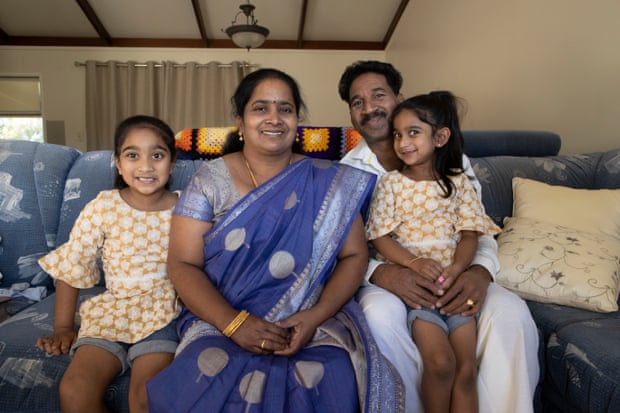
This family of Nades, Priya, Kopika and Tharnicaa Murugappan are well known to mainstream Australia as the ‘Biloela family’. They have captured our minds and our hearts ever since they were cruelly snatched away from their Queensland home by Australia Border Force and placed in immigration detention some four years ago. Their crime? For the parents to come to Australia by boat seeking asylum and, having settled into life in a small rural town, to be a day or two late in re-applying for a bridging visa.

The Federal Coalition government clearly wanted to make an example of this high profile family by deporting them to Sri Lanka and when this was foiled by the courts, to re-open the Christmas Island detention centre (at great cost to the taxpayers of Australia) just so it could house this one family. Adequate medical care was then denied to the youngest child who became seriously sick and had to be emergency airlifted to Perth Childrens Hospital. The family were then released into community detention until their ongoing court case could be resolved but barred from leaving Perth.

A change in government on 21 May saw a dramatic shift in the family’s fortunes. The new Labor government allowed them to return to Biloela last weekend and is making noises that they will be allowed to stay permanently. Their story is one of resilience and hope and the power of friendship and care provided by a dedicated group of women who advocated for the family’s return to Biloela. It is also a story of deliberate and calculated cruelty and lack of compassion by an Australian government more intent on the political benefit of ‘stopping the boats’ rather than providing any welcome or hospitality to refugees.

Refugee Week that runs 19-25 June gives us an opportunity to reflect on the turning point we may have reached in Australia’s asylum seeker policies. The Labor government has said that it will continue the policy of boat turnbacks when safe to do so and offshore processing (on Nauru) for any arrivals by boat, making their policy just as harsh as the previous government. But the treatment offered to the Nadesalingam family from Biloela offers a glimmer of hope that the large contingent of asylum seekers still living in limbo in Australia or stuck in detention will at least receive recognition and be treated as real people with stories to tell (often painful or traumatic) and hopes for their future.

May we remember Jesus’ call to treat others as we would have them treat us (Matt 7:12) and also that Mary, Joseph and baby Jesus were themselves refugees who relied on receiving hospitality in Egypt (Matt 2:13-15).

Paul’s story, our story and God’s story

Humans are born storytellers, whether it be stories shared with family members or friends, or whether it’s meeting with guests who come to our food bank or to Tuesday lunch or to our playgroups. Telling stories is part our human DNA and each person has a story to tell if we take the time to listen. Some of these stories involve hardship and resilience, some speak of care and compassion and some are the stuff of laughter and legend, especially in families.

The apostle Paul also has an interesting story to tell. While we may usually think of Paul in terms of dense theological arguments about Christ (e.g. Romans) or sorting our church problems (e.g. Corinthians), his life story is quite fascinating. He was brought up as a strict Pharisee, the sort of person who often opposed Jesus, and later he tried to actively suppress the church. After a memorable but mysterious encounter with the spirit of the risen Jesus, Paul’s life is completely transformed and he becomes an outspoken and passionate witness for Christ. But not immediately. After the encounter with Jesus it is nearly another 20 years before he begins his ministry. Perhaps it took him that long to reconcile his faith in Jesus with his earlier faith as a Pharisee.

As Christians, what gives our stories meaning and what gave Paul’s story meaning is how they interact with God’s bigger story that goes all the way back to creation. This bigger story involves the people of Israel, the insights of the prophets and wisdom writers, the coming and ministry of Jesus, the giving of the gift of God’s Spirit and the ongoing life of the church and of the wider creation.

On this Trinity Sunday it’s helpful to reflect on how we are invited to share in God’s story and to participate in the life of God. We each grasp different aspects of God’s story – creation, justice, worship, love, compassion, grace, forgiveness, inclusion – which is why it’s important that we listen to each other’s stories as well as to the all-encompassing story of God.

Surprising Spirit

Pentecost Sunday is one of the few days in the church year when we highlight the person and work of the Holy Spirit. So it seems a shame when we focus too much on some of the symbols associated with this day – wind and fire – both inanimate forces, which point to a powerful and perhaps threatening force at work (think storms and bushfires).

In the Acts 2 account that we usually read at Pentecost, the effect of the Spirit is certainly powerful, leading the disciples to praise God loudly and in multiple languages, which soon gathers a crowd of bewildered onlookers. The Spirit then emboldens Peter (and perhaps other disciples) to speak about Jesus and about the recent events of Easter. The Spirit challenges the hearers to respond and then gives vibrancy to the new community that forms. So the Spirit is indeed a powerful agent, pointing people towards God and towards Jesus and prompting life-giving responses.

This week we will instead be reading from the second Pentecost story that occurs in Acts 10, in which Peter is led through a series of Spirit initiated occurrences to speak to the household of a Roman soldier named Cornelius. The result is similar to the first Pentecost story with those present led to praise God and respond positively to the message about Jesus. The key difference is that this time around, those listening are Gentiles, non-Jewish people, Romans no less who were often despised by Jews.

This second Pentecost story illustrates that God’s Spirit often leads us to go beyond where we might feel comfortable, with surprising and life-changing results. It turns out that God accepts every person whose heart is open – everyone is acceptable to God, even those we might consider beyond the pale. So the person of the Spirit works powerfully and surprisingly. Where might the Spirit be leading each of us this Pentecost?

Be brave. Make change.

The headline slogan ‘Be brave. Make change’ is not a plea to the new Labor government from the Greens or Teal independents, although it would be an appropriate message to send. Rather it is the chosen theme for this year’s National Reconciliation Week that starts on 27 May and runs through to 3 June. This annual event provides an opportunity to learn about the histories, cultures and achievements of indigenous people, and the chance to explore how each of us can contribute to achieving reconciliation in Australia.

The apostle Paul uses the imagery of reconciliation and peace between estranged parties as one of the ways of understanding the death of Jesus. He argues that humanity was estranged from God – and from one another – but now God has acted decisively through the death of Jesus to bring both reconciliation and peace. This has not happened through human initiative or power, but rather through the gracious actions of God.

When we think of the often fractured relationships between indigenous people (the First Peoples of the land we call Australia) and later colonisers/settlers/immigrants (the Second Peoples), it is clear we have a lot of ground to catch up if there is to be true reconciliation and peace. A good start would be to listen deeply to each other. Indigenous people yearn for their voice to be heard, as expressed in the 2017 Uluru statement from the heart.

They want a voice to Parliament enshrined in the Constitution, a Makarrata (truth-telling) Commission and a treaty. Each of these requests will be challenging to implement and potentially costly for Second Peoples, but with a change in government, now is the time to act – to be brave and to make change. May God give our political leaders both the wisdom and the will to act, and all Australians the compassion and courage to respond positively.

Success and struggle go together

We all like winners, especially on the sporting field or in politics. We’re told that winners are grinners. We’re sometimes told that winning isn’t the main thing … it’s the only thing. But for every winner, there is nearly always a loser and often many, many losers.

So if we shift our thinking a little, what does success look like away from sport or politics? What does success in marriage look like, for instance? What would a successful outcome in Ukraine look like? What would a successful church look like?

One reading of the book of Acts is that the story is all about success. Large numbers of people come to trust in Jesus and new communities of faith spring up everywhere from Jerusalem to Rome. Women are involved in leadership as well as men. The Christian community models its life on the loving and inclusive ways of Jesus. Nothing, it seems, can hinder the spread of the word of God.

But there is another, darker side to the story. Mixed in with the success there is struggle and suffering. The apostles are harangued and imprisoned, Stephen is stoned to death, John’s brother James is executed by Herod and Paul stumbles from one struggle to the next, suffering floggings, imprisonments and nearly drowning. There are also struggles within the community as some groups get ignored and there are disagreements on how to handle difficult issues.

It seems as though success and struggle go hand in hand throughout the book of Acts, as they often do in our individual lives and in our community life. Depending on our personality we may view this tussle between success and struggle as the glass being half full or half empty. But when we face struggles in our walk of faith, it’s worth remembering that Jesus also faced many bitter struggles and warns his followers that they must take up their cross every day and follow in his footsteps.

We enjoy success … but struggle and suffering are part of our life too. Often the joys and successes we experience are all the sweeter if they have involved struggle. May God give us a right perspective that we might experience God’s presence and joy and peace in the midst of both our successes and our struggles.

God’s plan and our plans

People make plans all the time … whether it’s plans to go away on holidays (which for many of us have been on hold for the last two years), plans for how to celebrate an upcoming birthday or how we will spend Election day on 21 May, or plans for getting fit or losing weight. Such plans help add meaning to our life and give us a future to look forward to.

There’s a well-known verse in the book of Jeremiah that suggests that God has plans too, good plans … plans to prosper us, plans to give us hope and a future. This promise is spoken in the midst of a dismal medium-term outlook for Israel that includes loss of their land, loss of the temple and exile to Babylon. God seems to be saying that there is a bigger perspective here, if we have eyes to see it and trust to grasp it.

Jesus too had a plan for his followers that is summarised in Acts 1:8, namely that they would be his witnesses in Jerusalem, in Judea and Samaria and to the ends of the earth. In its historical context, this plan gives an outline of how the message of good news spread from its starting point in Jerusalem all the way to Rome, the centre of the then known world.

How might this plan apply to us today? It suggests that we begin where we are and live out our witness – through both our words and our actions – among our friends and our neighbours. As the opportunity arises, we can carry the message about God’s love and justice wherever we go. One benediction puts it this way … Go into the world in peace; carry God’s wisdom, speak forth God’s word and embody God’s love, wherever you are and whoever you meet.

Remembering Mother’s Day

This Sunday is that special day in the year when we get to say thankyou to our Mums and, depending on our family’s tradition, take Mum out to lunch, give her bunches of flowers or boxes of chocolates. This is all very nice and I’m sure most mothers appreciate the attention and love that’s given to them on this day. But of course being a mother is a 24/7, 365 days a year role that never really ends. One doesn’t ever ‘retire’ from being a mother and caring about one’s children.

While this is a happy day for many, it can also be a difficult day … whether grieving for one’s mother, dealing with a difficult relationship with one’s mother, lamenting that one couldn’t be a mother or struggling to make ends meet as a single parent. It also leaves out the many other significant women in our lives, whether they are aunties, sisters, wives, daughters, granddaughters or friends. These women are also worthy of our thanks.

While it is usually the men who feature in our Bible readings, this week’s description of the early Christian community in Acts 2 suggests that roles and responsibilities were evenly shared. The (male) apostles may have been the teachers, but it was almost certainly the women who provided the hospitality and the homes for people to meet in, as was the case during the ministry of Jesus. It takes the gifts of each person to build a community, so let us remember and be thankful for the wonderful gifts that so many women contribute.

What happened after the first Easter?

The story of Easter normally finishes with Jesus – risen from the dead – appearing to his disciples and commissioning them to go out into the world and spread his message of good news. Of the four Gospel stories we have, three of them – Matthew, Mark and John – finish in this way. The fourth Gospel – Luke – continues the Jesus story for another thirty years, thus giving us a valuable insight into what happened after the first Easter.

What did the disciples do? Luke tells us that they waited in Jerusalem and gathered together in prayer in the days leading up the Pentecost, when God’s Spirit was poured out upon them. This gift of the Spirit seemed to give the disciples a new boldness and confidence and they started telling people about Jesus and even healing people in a way similar to Jesus. This got them into trouble with the authorities, just like Jesus. Eventually the disciples were scattered and wherever they went, they continued to share the story of Jesus. And small communities began, formed of followers of Jesus.

Christian communities today are the spiritual fruit of the efforts of these early followers of Jesus who shared their message through both their words and their actions. The challenge for us today is to continue the never complete mission of Jesus to bring good news to the world. Many of us are comfortable doing this through actions of love and compassion. But we need to also tell the story of Jesus – in words. May God’s Spirit give us the boldness and confidence to do so and also the wisdom to know the right words to speak at the right time.

What to make of Easter

The story of Easter is brutal, confronting and enduringly evocative. Jesus, the one who was known as a compassionate healer and bold preacher, comes to Jerusalem at Passover time. After annoying the temple authorities he is arrested by the Jewish leaders, tried and then sentenced to death by the Romans. It all takes place very quickly and brutally and within a 24 hour period Jesus is dead and buried. Might and power have won over compassion and love. Hope has died.

His followers are in shock as to how this could have happened and are now afraid for their own safety. This should be the end of the story as the leader of the movement is eliminated. But then something unexpected and extraordinary happens. The tomb where Jesus’ body was laid is found to be empty and some of his followers see visions of angels saying Jesus is risen from the dead. Their grief turns to confusion and then to joy. Something changed them and energised them to take the message of Jesus out into the world. The most plausible explanation is that they encountered the risen Jesus.

When we look around at all the turmoil in the world, it’s obvious that might and power usually win (e.g. the Russian invasion of Ukraine). Compassion and love are for the so-called bleeding hearts who fail to see that strength and toughness are needed to overcome evil and injustice. And yet … and yet … the person of Jesus – his life, message, death and resurrection – has had a deeper and more lasting influence on humanity than any brutal despot or government. The story of Easter affirms that goodness is indeed greater than evil, that love is greater than hate and that life is greater than death (Desmond Tutu).

Easter services will be held at Croydon Uniting Church 1 Tallent st Croydon at the following times:

  • Tenebrae Service Thursday, 14 April 2022  7:30 PM – 8:30 PMService of light and shadows
  • Good Friday Friday, 15 April 2022  10:00 AM – 11:00 AM
  • Easter Morning Sunday, 17 April 2022  10:00 AM – 11:00 AM 

Welcome to Jerusalem

This Sunday is known as Palm Sunday and recalls Jesus’ entry into the city of Jerusalem. We are used to seeing signs when we enter a town or city. If they were a thing back in Jesus’ day (which they weren’t) such a sign might have read ‘Welcome to Jerusalem – capital city of Judaism’. For Luke, Jerusalem is a most significant place. It’s where the priest Zechariah had his vision in the temple, the place where Jesus was dedicated, the goal of Jesus’ long journey and of course the place of his passion, death, resurrection and ascension.

In Luke’s Gospel, Jesus set off for Jerusalem way back in chapter 9, so it’s taken a long time to reach the city. Luke has carefully built the tension in his narrative with regular reminders that Jesus is headed for Jerusalem and what will likely take place there. Now that he’s finally arrived, what sort of welcome will he receive?

His followers are excited, joyful and singing songs that speak of a righteous and victorious king entering the city in the name of God. They clearly regard Jesus as a king, the Messiah, based on his ministry and mighty deeds. They are looking forward to those in authority welcoming Jesus as the king who brings peace and hope and new life.

The Pharisees meanwhile, Jesus’ chief sparring partners through the whole story, try to dampen the buoyant mood and ask Jesus to tell his followers to be quiet. We’re also told that those responsible for the running of the temple, the heart of Jewish worship, are seeking to kill Jesus, especially after his action of disrupting the ‘business’ side of the temple’s operation.

All seems set for a high stakes showdown, where welcome will quickly turn to hostility and violence.