Season of creation

Spring has arrived – and with it the sense that nature is waking up from its winter slumber … wattles and blossoms are in bloom, bees are buzzing, birds are mating and some trees have starting sprouting fresh new leaves. It’s also the time to celebrate the Season of Creation (SOC), which runs through the whole of September each year.

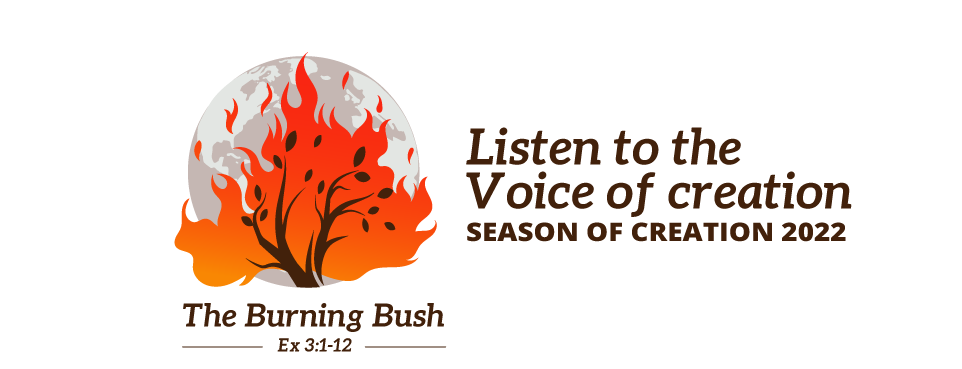
The symbol for SOC this year is the burning bush, which is taken from the story in Exodus 3 where Moses is intrigued by the sight of a bush that is in flame but not burning up. As he approaches for a closer look, God speaks from the heart of the bush and asks Moses to remove his sandals because he is standing on holy ground.

The burning bush as used in this symbol is engulfing the world in flame. It speaks of creation as under stress due to climate change, leading to higher temperatures and more wild weather events. These include fires in western Europe and western America along with new records for temperature in the UK (above 40 deg C) and devastating floods in Pakistan where a third of the country in under water. Nature and ecosystems are suffering.

The theme of SOC this year is listening to the voice of creation, which includes listening to the voices of those who speak on behalf of creation – scientists, ecologists, indigenous peoples, subsistence farmers and fishermen. And of course we can also go to the source and listen to sounds and voices of nature itself by spending some time along a creek or parkland – quietly listening to the various bird calls, frogs and insects.

What message are these voices telling us? Perhaps they are saying that it’s time to take off the sandals of our unsustainable lifestyles that are slowly killing the planet and reconnect with the holy ground of God’s earth.
Practising hospitality

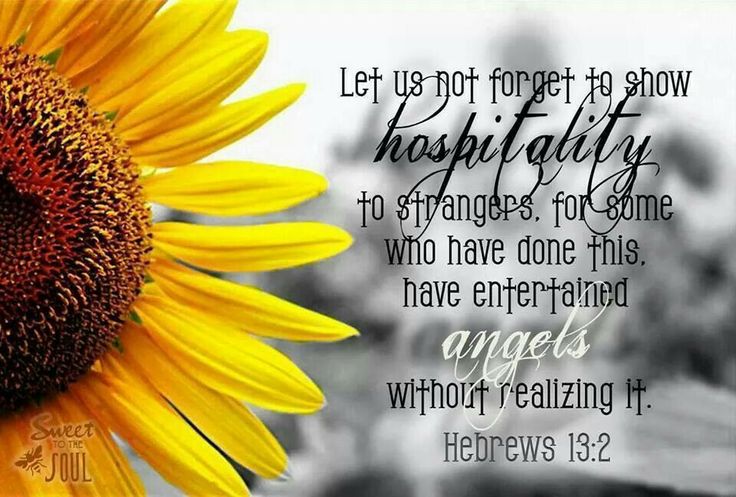
Offering hospitality is part of being human – it happens across all cultures and all religions. We are social creatures by nature. It’s one reason why the covid lockdowns were so difficult for so many people – we were cut off from gathering and meeting with family, friends and work colleagues – and despite the technical marvel of programs like Zoom, it just doesn’t provide the same experience as being in the same physical space with others.

Middle Eastern culture places a particularly high importance on hospitality, which is one reason why Jesus seems to spend so much time sharing meals with others. He was even maligned as being a glutton and a drunkard (Luke 7:34). As followers of Jesus, Christians are called to practise hospitality, for who knows – we may be entertaining angels unawares, as Abraham did (see Genesis 18). But Jesus suggests a few tweaks on normal social etiquette – such as inviting the poor, lame and crippled and not just your friends and family – and not expecting an invitation in return.

As a country we have much to learn about hospitality. Our treatment of refugees and asylum seekers over the last 20 years, for instance, is nothing short of shameful. Yet even when we locked up these people as prisoners for years, despite the fact that they have committed no crime, their desire to offer hospitality to visitors was amazing. They offered the one thing possible – making us endless cups of green tea in the visitor’s centre.

The great blessing – as well as the great danger – of offering hospitality is the possibility that we will be changed, that our understanding of life will be broadened, that our compassion and empathy for others will be deepened as we listen to the stories of our guests. May we learn afresh the joys of offering hospitality, despite the ongoing need to be careful to do so in a covid safe way.

Journeys of faith

Every one of us is on a journey called life. It had a beginning point, has many twists and turns along the way and will one day reach an end. Older people in particular, may be well aware that their journey of life is drawing to a close and may look back over their life with a mix of gratitude, fulfilment and regret.

Our journey of faith also traces out a path, although we may not be conscious of when it really started – whether in the womb (as suggested by Psalm 139), or gradually as we discovered more about the world or at a definite point in time. Along the way our journey of faith may involve cul-de-sacs, brick walls, exhilarating mountain top experiences, routine and habit. Hopefully for all of us there is a growing edge to our faith, whatever stage of life we are up to.

In this week’s challenging reading from Hebrews two journeys of faith are contrasted. The first is the journey of the Israelites from slavery in Egypt to Mt Sinai where Moses receives the Ten Commandments and many other laws. The description of the scene at Mt Sinai is intended to convey awe and wonder – as Yahweh descends on the mountain in storm and fire. The earth shakes and the people are terrified. It’s as if the writer is telling later generations how awesome and powerful the presence of God is and therefore how they must obey God’s every command as though their very life depends on it.

This journey of faith is contrasted with a Christian’s journey of faith that will culminate in God’s glorious presence in heaven, surrounded by angels and all the saints who have gone before. Amidst all the struggles and challenges of life on earth, only two things are truly dependable and solid, namely God and the kingdom Jesus is building. So the message in this case seems to be to endure whatever hardships life may throw at you because your journey will end in the glorious presence of God.

Two journeys of faith towards two apparently quite different destinations. Yet the journey is towards the same God in each case. So it is with each of us. Our journey of faith is unique to us yet it has a common end point – the presence of God. So the author seems to be saying that however difficult or routine or amazing our journey of faith is – and it may be all this and more over our lifetime – keep your eyes fixed on the final destination of the journey and the hope of enduring life in God’s presence.

Faithfulness and focus

Faith is a many splendoured experience that comes in various forms. Sometimes faith is knowing something deep inside that you just know to be true. Sometimes faith is more like a hunch or an intuition. Sometimes faith is borne from past experience, such as knowing that the light will come on if I turn the switch. Sometimes (often in fact) faith is a form of trust, such as following a course of medication or having a vaccine because we trust the medical science.

Spiritual faith is trusting in the goodness and loving kindness of God even when our situation or circumstances may suggest that we are all alone in the world, forgotten by God. In the ‘Hall of faith’ chapter in Hebrews 11, there is a list of famous people of faith from the Scriptures placed alongside another list of unnamed people of faith who suffer misery and persecution. All are commended for their faith, which suggests that having faith is no guarantee that life will be easy and, conversely, that suffering is not caused by a lack of faith.

The passage then encourages us to persevere in our own ‘race’ of faith in the light of this multitude of both ‘successful’ and ‘suffering’ forms of faith. In this race we are encouraged to persevere through the hard times that will inevitably come our way at some stage or other, focusing especially on the example of Jesus who is the beginning and end of our life of faith, the pioneer and perfecter of our faith (Heb 12:2). As we know, Jesus endured great shame and agony on the cross, but then experienced joy. We can expect to experience similar challenges – and joys – as we follow in the footsteps of Jesus, who is the source and inspiration of our faith.

Living with faith

When I was a young adult I admired people of faith. I wondered how they could be so certain about the big questions of life when to me everything seemed quite uncertain. I think I made the common mistake of contrasting faith with doubt, assuming that a person with faith must have no doubts.

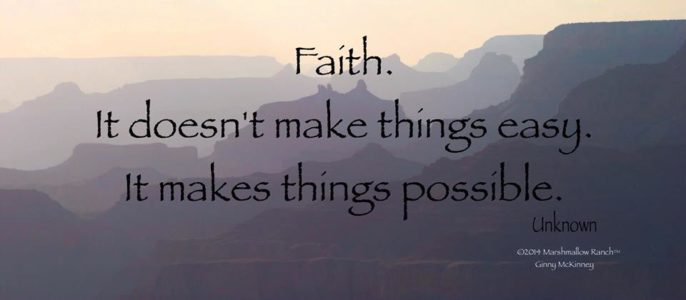
These days I would call myself a person of faith – but that doesn’t mean that I have everything figured out. Rather, it seems to me that faith is having the courage to trust what you can’t fully grasp, despite the uncertainty, as suggested by the above quote from Brene Brown. The book of Hebrews states it this way: faith is confidence in what we hope for and assurance about what we do not see (Heb 11:1).

So when I look at the world I see plenty of reasons for doom and gloom and many situations that seem impossible to resolve, such as the ongoing war in Ukraine or the climate emergency that we seem no closer to solving. But faith is trusting in God and God’s promises in spite of the difficulties and struggles that surround us every day. It is having the courage to trust that following the way of Jesus will make a positive contribution to the world and the people around us.

Learning to pray

Prayer is a deeply spiritual practice that crosses many religions. People pray for all sorts of reasons – for protection and security from evil, for the healing of a loved one, for rain or for it to stop raining, to connect with one’s god. Even non-religious people pray in times of extreme anguish. People like the slave trader John Newton, who – afraid that he was about to drown during a fierce Atlantic storm – cried out to God to save him – promising to turn his whole life around. Newton survived the storm, gave up slave trading and became a Minister and hymn writer, whose best known hymn is the classic Amazing grace.

In this week’s gospel reading from Luke, the disciples observe Jesus at prayer and ask him to teach them how to pray. As faithful Jews they would have prayed at least three times every day, so the request is more about how to pray like Jesus. The prayer Jesus teaches them – known to us as the Lord’s Prayer – is short and memorable, less than 60 words, which one can recite from memory in under a minute.

Why then do we so often find prayer difficult? Perhaps it’s because we have a transactional view of God – that if we do this (e.g. pray) then God will do that (e.g. grant our requests). This seems to miss the point of prayer which is about building relationship and trust. We don’t pray to try and twist God’s arm to give us what we want, but rather so that we will be changed through the practice of prayer and will come to understand more of God’s character and God’s perspective on the world. We also tend to fill our prayer times with our words and find it much harder to be still and to listen to what God may be saying to us.

A disciple is a learner – and when it comes to prayer we are all learners. There is no one right way to pray or right place to pray – just read through the book of Psalms, which is the Bible’s prayer book. If you struggle with prayer this is a good place to start. If we listen to Jesus we will learn that prayer can be very simple, but whose daily practice helps connect us with God.

https://youtu.be/1a_jJUgxzuI

Getting the balance right

We often hear these days about the need for people to get their work/life balance right. This dilemma has been highlighted by the trend of working from home that was encouraged during covid lockdowns. The home became the place of paid work as well as the place of learning for many students. The home is of course also the place one lives one’s personal life. So where does work (or study) begin and end and how does this impact the rest of life?

A similar issue lies behind this week’s Gospel reading about two sisters, Martha and Mary. It appears that Martha is in charge of running the house and expects her sister Mary to help out as required when Jesus and his band of travelling disciples arrive for a meal. Providing hospitality to guests was both an honour and an expectation in Eastern culture. And the role of women was to organize the hospitality. This was considered to be women’s rightful ‘work’.

The problem is that Mary decides that she will sit and listen to Jesus’ teaching – alongside the other male disciples – while Martha prepares the meal. Martha is unimpressed and interrupts Jesus to demand that he persuade Mary to get back into the kitchen to help out. Instead, Jesus commends Mary and suggests that she has chosen what is the ‘better part’.

What’s at stake is more than a feminist rebellion against imposed gender roles. The situation asks us to consider how to balance the demands of discipleship (learning to follow Jesus) with other demands in life (e.g. work, home schooling, running a house). Jesus often invites people to follow his example which cultivates the inner life of relating to God (e.g. through prayer, worship, stillness) but is also fully involved in life in the world (e.g. work, community building, helping others). The challenge – as with the question of contemporary work/life balance – is how to balance these distinct yet overlapping spheres of our lives.

NAIDOC invitation

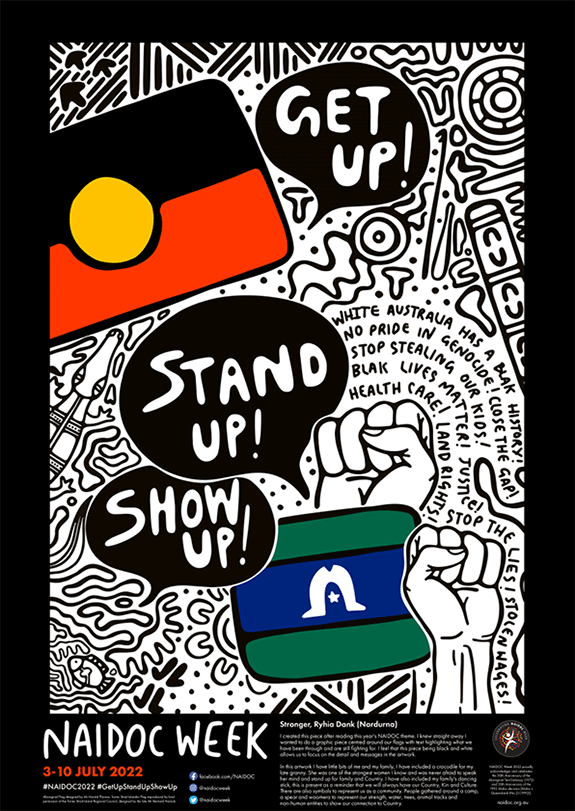
This week is NAIDOC Week that provides us all with the opportunity to remember and celebrate the culture, history and many achievements of indigenous people in this country now called Australia. The week-long celebration grew from the Aboriginal Sunday promoted by William Cooper back in 1938 to mark the Sunday before Australia Day each year as a day of mourning for indigenous people. Under the promotion of the National Aborigines and Islander Day Observance Committee, NAIDOC has been extended from a day to a whole week and has moved from January to July.

The theme this year is Get up! Stand up! Show up! It’s a reminder of how indigenous people have indeed got up, stood up and shown up in defence of their lands and culture against the invading colonisers and in the long fight for recognition, rights and treaty that continues today.

It’s also an invitation for the Second Peoples of this country to get up, stand up and show up as allies and advocates for the First Peoples. This is more than offering an acknowledgement of country at the start of a meeting or event. It’s an attitude and aspiration of being willing to do more in this space and to walk with the First Peoples in their struggle for justice.

The OT prophet Amos rails against the complacency of the people of his day towards injustice and urges them to instead make justice roll down like a river and righteousness like a never failing stream (Amos 5:24). In our day, justice for indigenous people includes closing the gap on so many basic issues such as housing, health and rates of imprisonment. It also means having the courage and active will to implement the Uluru Statement from the heart to give indigenous people a voice to Parliament, to establish a makarrata truth-telling commission and to work towards a treaty.

While these are grand visions on a national scale, we can also work at a local level. The Assembly of the Uniting Church encourages each local congregation to reach out and connect with their local indigenous mob … not to solve problems but to develop a relationship. And then to listen, to listen deeply and then listen some more to the stories and history and lived experience of our local indigenous brothers and sisters.

Do good to all

The data from the latest 2021 Australian Census published this week shows a continuing decline in the number of people who identify as Christian and a corresponding increase in the number who identify as no religion. In some ways this simply continues the trend that began in the 1970s and is therefore hardly surprising. On the other hand, the data suggests that people who may identify themselves as ‘spiritual’ do not want to become involved with institutional Christianity.

Why is this? It may be due to past appalling conduct perpetrated by the church (e.g. child sexual abuse) but may also reflect the declining levels of trust in all institutions by younger generations, whether the church, the scouting movement, community groups such as Rotary or various levels of government. It may also be due to a perception that Christian beliefs are illogical and irrelevant to contemporary life.

But perhaps we shouldn’t be too perturbed by the Census data. Back in the day when the New Testament was written, the Christian proportion of the population was quite small and was competing against many other faiths and belief systems. When we read the writings of people like the apostle Paul he was certainly keen to get the church’s theology right, but he was also passionate about the followers of Jesus living in such a way that their faith practices were noticed and made a difference to the people around them.

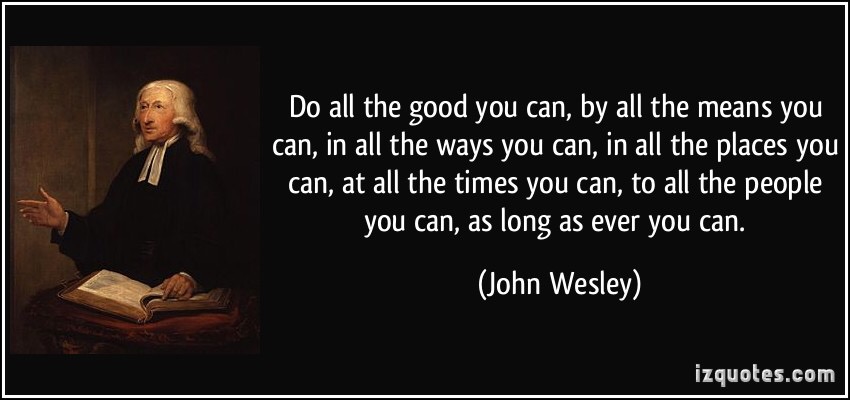
So in this week’s reading from Galatians 6 for instance, Paul implores the people of God to do good to all and to never tire of doing good. Paul hoped that the consistent loving actions of Christians would establish their reputation as good citizens who helped the most needy in society and who looked after their own with compassion. John Wesley expressed this same idea in the memorable way as above. May we indeed do all the good we can … to all the people we can … for as long as ever we can.

Called to freedom

Freedom is a gift and a right that we don’t often think about in this country Australia. We are used to doing what we want, when we want and with whom we want. But those of us who live in Melbourne have had a taste of what life is like when certain freedoms are removed. During covid lockdowns in the last two years we were not allowed to gather together, not allowed to travel and not allowed to leave our homes at all except for a very limited number of reasons. When the restrictions were eased, we delighted at once again being able to meet with other people and being allowed to participate in communal activities.

Paul places freedom at the heart of the gospel, along with grace and faith. In his letter to the Galatian churches, this freedom is focused on being liberated from the Jewish Law with its many restrictions and regulations. We can enjoy right relationship with God based purely on our faith in Jesus Christ and what he has done for us.

Because of this insistence that we don’t need to follow the detailed demands of Jewish Law, Paul is seen as a bit of a trouble-maker and rebel … like Jesus before him! But Paul turns this on its head by suggesting that we are to use our freedom to love and serve others, effectively becoming a slave … the very opposite of a free person.

So while freedom is a fundamental right, it’s possible to abuse our freedom for selfish or indulgent ends. Instead, sometimes we have to curtail our freedom to best serve others. This was seen during the covid lockdowns when the vast majority of Melburnians complied with the restrictions and curtailed their freedom for the sake of loving and serving others by keeping them safe. Sadly this attitude has largely disappeared and selfish indulgence is back in charge.

May God give us wisdom to discern how to use and enjoy our freedom – in ways that serve the interests of others.