The Spirit at Pentecost – bringing peace or disturbing the peace?

The Christian festival of Pentecost is one of the three great festivals celebrated by the church each year, alongside Christmas and Easter. It tells the story of God’s Spirit being poured out on Jesus’ followers and how this experience and its aftermath was decisive in forming the new movement that we know today as the church.

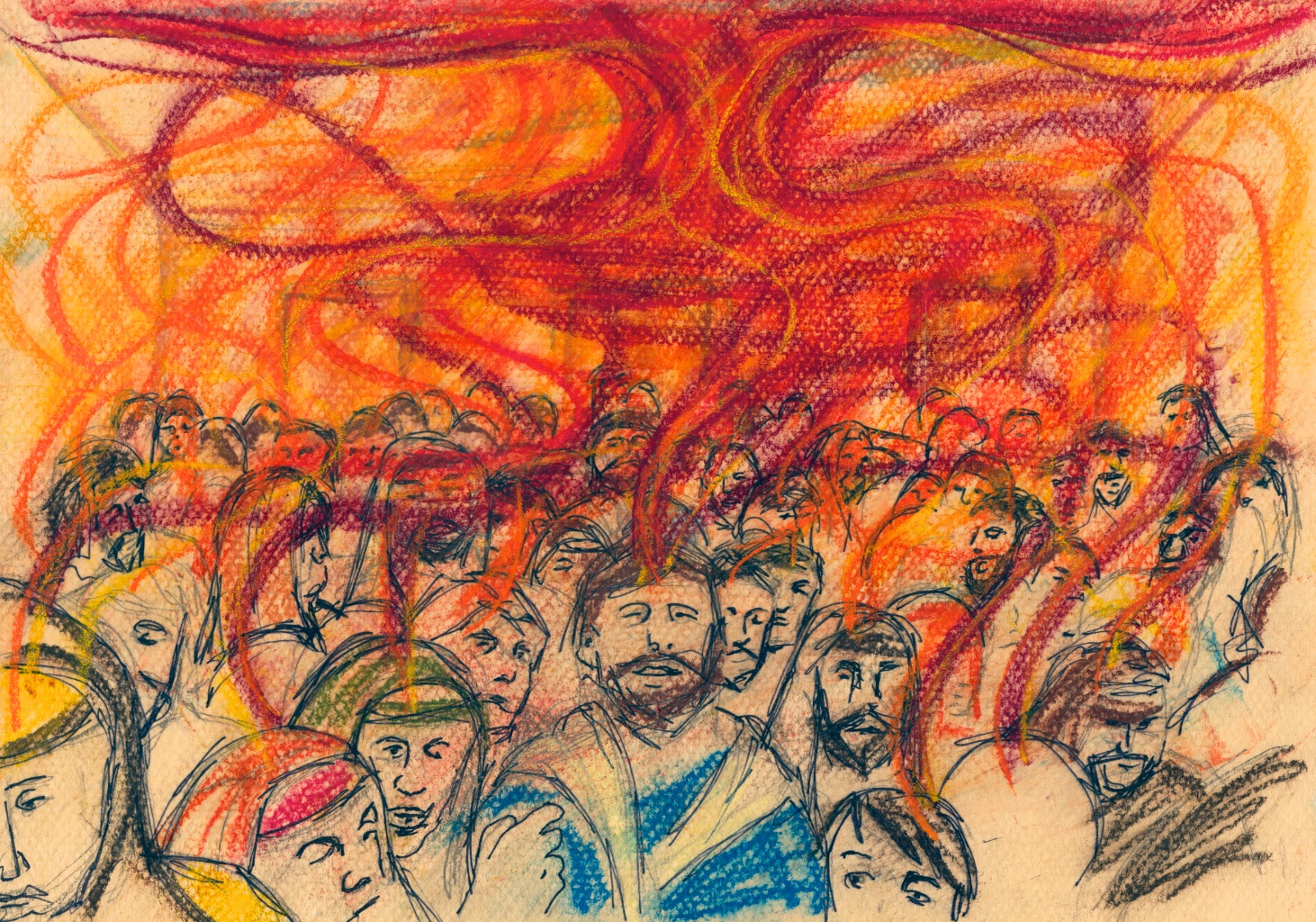
God’s Spirit is imagined in different ways in the Bible. In the first reference – in the opening verses of the very first book of Genesis – the Spirit is the wind or breath of God moving over the waters. If we fast forward to the start of Jesus’ ministry, the Spirit descends on Jesus at his baptism in the form of a dove. In the Gospel of John, Jesus speaks of the coming Spirit as the Advocate or Helper, the presence of God drawing alongside God’s people to bring comfort. At Pentecost, the outpouring of God’s Spirit is marked by wind and fire and the immediate response of God’s people to praise God in various languages.

So it is hard to tie down the Spirit to a single image or role, which is not really very surprising, as the Spirit is the essence and presence of God alive and at work in the world, even before creation.

An interesting question to consider is whether the Spirit’s role is more to provide peace and comfort (as suggested in the Gospel of John) or whether to disturb the peace (as suggested in the story of Pentecost). Most of us would probably prefer the option of bringing peace, yet often in the Bible the Spirit seems to do the opposite, stirring up people to speak or act for God.

May God’s Spirit move among us afresh today, bringing peace where there is conflict and suffering but also disturbing the peace where we have grown too comfortable with the status quo. Come, Holy Spirit, to bring life and hope!

Jesus and prayer

Prayer is often seen as a key part of our walk of faith. At its simplest, prayer is talking with and listening to God. Yet for many Christians, prayer remains a source of guilt and anxiety. We feel that we should pray more, or pray better, or pray more effectively. Some people view prayer as largely a waste of time that serves no practical purpose in the world. Despite these doubts, prayer remains a core element of Christian practice the world over and a source of blessing and encouragement.

Jesus completes his farewell teaching to the disciples by praying what is often called the High Priestly Prayer. In this prayer he prays for himself in the light of his impending death on the cross, for the disciples and for the later church (those who will come to believe based on the witness of the disciples). The prayer includes many of the key themes of John’s Gospel – glory, eternal life, faith, truth, Jesus’ origins and relationship with God. It also looks ahead to the time of the church as Jesus prays that his followers would be protected from evil, would be united in heart and purpose and would know the love and joy that comes from God as they witness to Jesus.

As humans, our life depends on breathing. We breathe in and we breathe out from the moment we are born until our dying breath. If our actions of compassion and service and witness in the world are how we breathe out spiritually, then prayer and worship are key parts of how we breathe in spiritually. It is through prayer that we are refreshed, encouraged, unburdened and remain connected with God.

There is no one right way to pray, or place to pray, or time to pray. Try to find a way, a time and a place that works for you and don’t be afraid to change it around occasionally. Listen out for God’s whisper in your heart that you are indeed a precious child of God and deeply loved by God. As you listen and talk, prepare to be surprised where prayer may take you.

We remember mothers and their love

This Sunday is celebrated as Mother’s Day in Australia. It provides an opportunity for children to make their mother breakfast-in-bed, to give a bunch of flowers and a ready excuse for a family get together. There is of course also the commercial pressure to buy Mum this or that gift that she may or may not really want.

The odd thing about Mother’s Day is that we set aside just a single day to pause and remember all the amazing things that mothers do each and every day of the year … nurturing, caring, catering, managing, encouraging, helping, sharing common sense. And that’s not to mention that each of us only came to be born into this world through the painful labour of childbirth endured by our mothers.

It’s interesting that when Jesus is wanting to share the news about how his impending death will affect the disciples, he uses the illustration of childbirth. They will feel great pain – just as a mother feels great pain during labour. But just as the pain turns to joy for a mother when her child is born, so the disciples’ pain will turn to joy when they see Jesus alive again after the resurrection.

These pangs of childbirth are what it will take to bring Jesus’ vision for new life fully into being … a vision where every person is welcomed with respect and dignity, where loving and serving one another irrespective of our status or gender or background are the norm, where suspicion and animosity are replaced by kindness and acceptance. Wouldn’t it be great if this vision was lived out not just on a day like Mother’s Day but every day.

Staying connected with Jesus

In our digital age, connections are all important, whether it’s the level of bars on our phone reception or the performance of our nbn connection. Problems arise when the connection is weak or broken. Just this week I was trying to set my Mum up with a new bank account and was trying to fill in all the details required at a computer at the bank. Despite trying several times, the internet connection kept dropping out so that I had to go back to the start of the form each time. We then tried a different computer with a better connection and it all worked okay.

Chapter 15 in John is all about connections, especially our connection with Jesus and through Jesus to God. John uses the metaphor of a grapevine, with Jesus claiming himself to be the vine, God as the gardener and followers of Jesus as the branches. The purpose of a grapevine is to grow and produce grapes of course with all these elements staying connected and working together. In a spiritual sense, we must stay connected with Jesus if we are to produce fruit in our lives.

How does this happen? Jesus teaches that his words and his ways must remain in us, especially the command to love one another. We are called to follow the example Jesus set of washing his disciples’ feet at the Last Supper and later his willingness to lay down his life on the cross for the sake of his friends.

This is hard teaching that may make us anxious about how we will in fact remain connected with Jesus through all the ups and downs and trials of life. The good news is that Jesus is wanting to hold on to us, through the gift of God’s Spirit, just as much as we want to hold onto Jesus. So we do not have to strive or be anxious, but rather live into the relationship that Jesus makes possible.

Life after Jesus

We sometimes think that living as a Christian in a secular culture like Australia is quite difficult. The church has been pushed to the margins of our society, has a shrinking and often older cohort of members and is regarded with suspicion or hostility by many people due to past failures (e.g. abuse of children that was then covered up). All of this is true, yet it doesn’t paint the whole picture. Compared to other parts of the world, we live in a relatively tolerant culture that doesn’t actively persecute Christians nor stop us gathering for worship.

Most students of history would suggest that the emerging Christian church had a much tougher position than ourselves, awkwardly caught between a hostile Jewish community and a polytheistic pagan culture. They were also a relatively tiny group and now without their charismatic leader. If they were to survive and indeed to thrive, they would need a clear understanding of their mission and approach. The long teaching section in John’s Gospel in chapters 14-17 offers guidance for the time after Jesus.

Two early themes that stand out from these chapters are the call to continue Jesus’ ministry and the promise of God’s Spirit to help and guide them. These provided clarity of purpose and hope in the present and for the future. Whenever we become despondent about our future or weighed down by our secular culture, we would do well to reflect on the call to us to continue the ministry of Jesus and the promise of God’s Spirit to be with us and to encourage us.

Starting over

The final chapter in John’s Gospel feels quite ordinary compared to its grand opening chapter that spoke of the Word of God becoming flesh and dwelling among us bringing light and life. In the final chapter we have a story about fishing and sharing a BBQ on the beach and a conversation between Jesus and Peter. It’s rather laid back and relaxed, though not for Peter.

The presence of Jesus sitting by a fire surely brings back for Peter bitter memories of the last time he sat round a fire and denied even knowing Jesus three times over. Peter is probably feeling embarrassed, ashamed and so disappointed in himself. Rather than rebuke him for his failures, Jesus asks Peter three times if he loves him, to which Peter replies ‘you know that I love you’. Jesus then commissions Peter to carry on the mission of the Good Shepherd by feeding the flock, namely the emerging church community.

Failure and disappointment are met with grace, forgiveness and healing. Jesus gently restores Peter and helps him to start over. I wonder if there are relationships in your life or in your community that need a similar word of grace to help them start over.

A new day dawning – light overcomes the darkness

The Easter story begins in darkness in John’s Gospel as Mary Magdalene goes to the tomb. We’re not told why she is there, but can guess it was to be alone to grieve. A number of surprises await her. The first is that the large stone used to seal up such a tomb had been removed, suggesting foul play of some sort. Mary goes and alerts the male disciples who also come to the tomb to investigate. The body of Jesus is missing.

Mary returns to the tomb, drawn to it like a moth to the light. The new day is dawning and light is steadily replacing the darkness. Mary sees someone that she assumes to be the gardener and asks him if he has taken the body away. Then just a single word – Mary! – is enough to waken her from her grief. She knows that voice – it is the voice of Jesus speaking to her.

She is given a task and a message – go and tell the other disciples that Jesus is indeed alive again and is returning to God, to his Father and their Father. Mary has the privilege of being the first witness of the risen Jesus, playing a key part of the Easter story in each of the four Gospel accounts.

Mary’s role seems so appropriate in this new chapter of the story as it moves from darkness to light, from death to life and from despair to hope. The new movement that will soon enough turn the whole world upside down – inspired by the life, message, death and resurrection of Jesus – will break down barriers between men and women, between Jews and pagans and between slaves and free. All people are acceptable and all are equal before God. And Mary is the first witness of this new day.

The cross of Jesus – shame or glory?

On Palm Sunday each year, we remember the story of Jesus entering Jerusalem, riding on a donkey. The people throw their cloaks on the ground and wave palm branches as they sing a song that welcomes the king into the city (taken from Psalm 118). Jesus adds to the spectacle by deliberately choosing to ride the donkey, acting out a prophecy from the Scriptures (in the prophetic book of Zechariah) about the king coming in humility and peace and riding on a donkey.

Not everyone is pleased to see Jesus being feted in this way. His regular opponents throughout the Gospel story, the Pharisees, grumble about how the whole world seems to be going after Jesus. John’s Gospel then includes an odd little incident to show that this statement is quite true. Some Greeks – non Jewish people – are visiting Jerusalem for Passover and have heard about Jesus and want to see him and request an audience through two of his disciples.

For Jesus this is the sign that his message is indeed reaching into the world. It recalls the well-known verse from earlier in this Gospel that the reason Jesus came into the world was because God loved the world so much. For Jesus, the decisive hour is now within view – the climax of his ministry.

From one perspective, the death of Jesus is a story of rejection and betrayal, of brutality and shame as he dies an agonising death on a cross. From John’s perspective, however, being lifted up on the cross is the moment when Jesus is glorified and draws all people to himself. It is the means by which God’s love is fully revealed to the world and also how God’s life is made available to all.

So how do you see the Easter story? Is it a story about the darkness and evil that dwells in the human heart? Or is it a story about the light and love and life that God wants to bring into the world? Or is it a strange combination of both these stories?

The beginning of the end for Jesus

I wonder if you have had the privilege of sitting with a dying person or sharing time with family members immediately following the death of a loved one. Usually few words are spoken, but it is often a special and even sacred moment. Death has a way of stripping away our masks and trivial concerns. A precious person’s life journey has ended, and those remaining must begin a new chapter without the ongoing presence of the one who’s died.

When Jesus’ friend, Lazarus, died, Jesus wasn’t there. So his missed out on the rawness of the death and the grief that followed. But when Jesus does turn up, recriminations flow freely from Martha and Mary, the sisters of Lazarus. If you had been here, our brother would not have died … Moved with compassion, Jesus visits the tomb where the body has been laid, prays and then calls to Lazarus to come out. Lazarus emerges, alive again!

Based on this incident, Jesus claims to be the resurrection and the life, the one who promises to give life to us even though we die. It is also the seventh and final ‘sign’ in John’s Gospel that points to Jesus as the one who has come to bring life – eternal life – to the world. This sign stirs the imagination of the people and also hardens the opposition against Jesus. It is the event that precipitates the beginning of the end for Jesus as we move rapidly towards the events of Easter.

This story adds to the mystery surrounding death. Will we live again, even though we die? What will that new life look like? And do we need to fear death? May God give us hope and wisdom as we ponder these questions.

Jesus the good shepherd

I’m not sure how much you know about sheep and shepherds. If you’re like me, I suspect the answer is not too much. We may think of sheep as cute and cuddly, which is true if we think of newborn lambs. A fully grown sheep, however, weighs in at some 100 kg and is a strong and sometimes stubborn animal. Shepherds leading small flocks of 50 to 80 sheep are a Middle Eastern tradition whereas in Australia flocks tend to be much larger and are rounded up with sheep dogs or quad bikes.

So how do we relate to Jesus calling himself the good shepherd in John chapter 10, with ourselves as the sheep?

Sheep have certain needs – for grass and water – that a shepherd takes care of. So if Jesus is the good shepherd, he provides for our basic needs. This is similar to the line in the Lord’s Prayer asking God to give us our daily bread.

Sheep are vulnerable to certain marauding predators like wolves or foxes. In the Middle East, the shepherd keeps them safe by building a sheepfold (enclosure) and by sleeping across the entrance. As the good shepherd, Jesus promises to stay close to us and never abandon us.

In Jesus’ thinking, the sheep are so valuable that as the good shepherd he is prepared to lay down his life for the sake of the sheep. This points ahead to the cross where Jesus’ death will – in a paradoxical way – bring life to those who trust in him.